Every 24 hours, Nigerian roads claim lives. Motorcycle accidents on rural roads, vehicle collisions on expressways, industrial injuries in factories, and falls on construction sites all of these create an unrelenting stream of trauma patients who arrive at emergency departments needing immediate surgical intervention. In that moment, a surgeon’s skill is only as good as the equipment in their hands.
Yet across many hospitals in Nigeria from federal teaching hospitals to rapidly expanding private facilities the story is the same: equipment shortages, delayed deliveries, implants of questionable quality, and suppliers who disappear after the sale. For procurement officers and hospital administrators trying to build reliable surgical capabilities, finding the right trauma surgery equipment supplier in Nigeria is one of the most consequential decisions they will make.
This guide exists to help you make that decision well. No fluff. No product pitches. Just a clear, honest framework for evaluating and choosing a supplier you can actually depend on.
Why the Demand for Trauma Surgery Equipment in Nigeria Is Growing Fast
To understand the supplier landscape, you first need to understand the demand side. Nigeria’s need for trauma surgical equipment is not a passing trend it is structural, driven by several converging forces.
Road traffic accidents remain one of the leading causes of traumatic injury and death in Nigeria. According to the World Health Organization, Nigeria consistently ranks among the countries with the highest road fatality rates globally, with hundreds of thousands of accident victims requiring fracture fixation, soft tissue repair, or emergency surgical stabilisation every year.
At the same time, Nigeria is witnessing a growing demand for orthopaedic implants, driven by a rise in sports-related injuries and active lifestyles. Patients and healthcare providers are increasingly seeking advanced implant solutions that offer durability, reliability, and the flexibility to be tailored to individual patient needs.
The broader market picture reinforces this. The Middle East and Africa surgical equipment market was valued at USD 549.8 million in 2024 and is projected to reach USD 1.06 billion by 2033, growing at a CAGR of 7.57%, driven by rising injury rates, infrastructure investment, and growing adoption of advanced surgical techniques.
On the supply side, Nigeria depends largely on imports for medical devices, with over 98 percent of its equipment needs supplied by imports, while local production remains very limited. This makes the choice of your international or distribution-linked supplier even more critical because if your supply chain breaks, there is no domestic fallback.
For hospital procurement teams, this is both a challenge and an opportunity. The market is growing, the need is urgent, and hospitals that build strong supplier relationships today will be far better positioned to handle tomorrow’s caseload.
What Counts as Trauma Surgery Equipment? Know What You’re Sourcing
Before evaluating any trauma surgery equipment supplier in Nigeria, you need to define precisely what you are sourcing. “Trauma equipment” covers a wide spectrum, and different suppliers specialise in different segments.
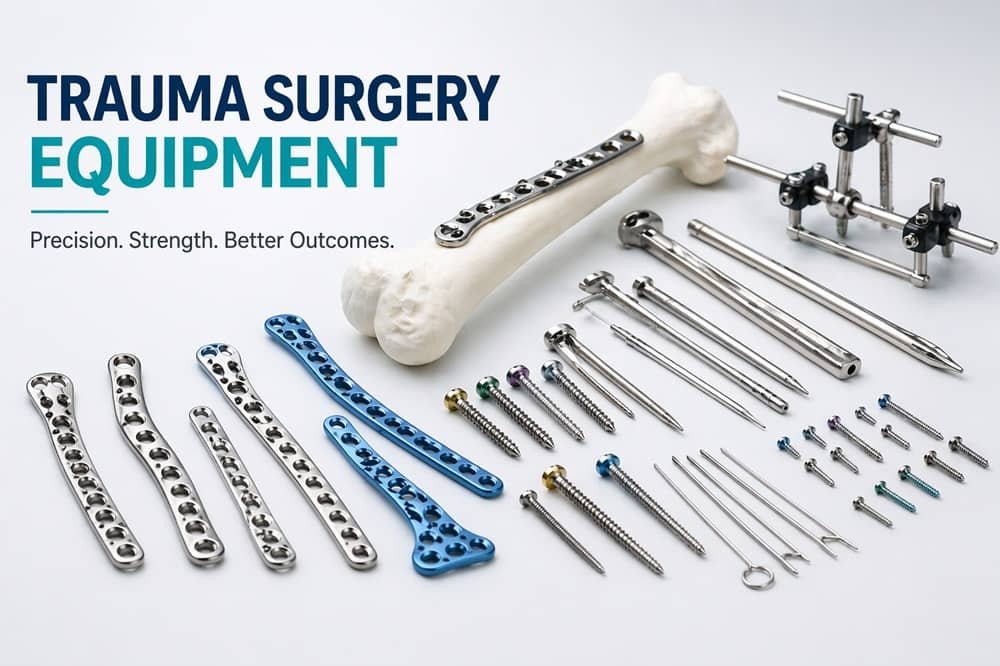
Internal fixation devices are the core of orthopaedic trauma surgery. These include bone plates, cortical and cancellous screws, intramedullary nails, and locking compression plates (LCPs). Internal fixators are projected to dominate the global orthopedic trauma device market with 80.6% of total market share in 2025, led by strong adoption of plates, screws, and intramedullary nails for complex fracture stabilisation.
External fixation systems are used primarily in open fractures, complex multi-fragmentary injuries, and emergency damage control situations where internal fixation is not immediately feasible. These include unilateral, circular (Ilizarov-type), and hybrid frames.
Soft tissue instruments form the backbone of the trauma theatre: retractors, forceps, scissors, needle holders, clamps, and bone reduction tools. These instruments must be made from surgical-grade stainless steel and undergo validated sterilisation cycles.
Power tools including oscillating saws, drill systems, and reaming equipment are essential for fracture repair. These require reliable battery systems or pneumatic connections and must come with compatible accessories and servicing agreements.
Emergency and theatre consumables include tourniquet systems, wound irrigation equipment, bone wax, and haemostatic agents. These require consistent restocking and short lead times given their disposable nature.
Understanding this breakdown allows you to ask your supplier the right questions upfront: do they cover your entire trauma equipment need, or do they specialise in only one segment? A supplier who can cover your full operating theatre requirements from implants to instruments to consumables reduces your procurement complexity significantly.
The Non-Negotiable: Regulatory Compliance for Trauma Surgery Equipment Suppliers in Nigeria
In a market where counterfeit and substandard medical devices still circulate, compliance is your first and most important filter. A credible trauma surgery equipment supplier in Nigeria must be able to demonstrate the following without hesitation.
NAFDAC Registration is mandatory. The National Agency for Food and Drug Administration and Control is Nigeria’s regulatory authority for medical devices. Any trauma implant or surgical instrument sold or used in Nigeria must carry a valid NAFDAC registration number. Before any commercial conversation proceeds, request this documentation and cross-check it on the NAFDAC portal. If a supplier cannot provide it for their products, walk away immediately.
CE Marking signals European conformity meaning the product has passed documented safety, performance, and bio compatibility evaluations against EU medical device regulations. For trauma implants, this includes mechanical fatigue testing that confirms the plate or nail can withstand physiological loading without premature failure.
ISO 13485 Certification is the international quality management standard for medical device manufacturers. A supplier or manufacturer holding a current ISO 13485 certificate has demonstrated that their production environment, quality controls, documentation systems, and post-market surveillance meet global standards. Always check the certificate’s issuing body, scope, and expiry date.
FDA 510(k) Clearance (United States): While not a Nigerian regulatory requirement, FDA-cleared devices have passed rigorous safety and effectiveness evaluations. For hospitals aiming for internationally comparable standards of care, FDA clearance is a useful additional marker of credibility.
Do not simply accept photocopied certificates. Ask suppliers to provide original documents or verifiable links to regulatory databases. A supplier confident in their compliance will welcome the scrutiny.
Evaluating Product Quality: What Your Trauma Surgery Equipment Supplier Should Be Able to Prove
Regulatory documents tell you a supplier has met the minimum bar. Product quality evaluation tells you whether their devices will perform under the stress of real surgery. Here is how to assess it.
Material traceability matters more than marketing claims. Trauma implants must be manufactured from materials that meet defined standards: titanium alloys should conform to ASTM F136 (Ti-6Al-4V ELI), and surgical stainless steel should conform to ASTM F138 (316L). These are internationally recognised specifications that define allowable impurity levels, tensile strength, and corrosion resistance. Ask your supplier for material certificates per batch known as certificates of conformance or mill certificates and check that they reference the correct ASTM or ISO standard.
Sterility documentation is critical for implants and theatre instruments. Every packaged implant should arrive with a sterility assurance level (SAL) of 10⁻⁶, and packaging integrity should be verifiable through manufacturer batch records. Examine packaging on arrival: any breached seals, missing sterilisation indicators, or illegible expiry dates should result in immediate rejection of the batch.
Instrument set completeness is a practical concern that many hospitals overlook until they are in the operating theatre. Trauma surgery requires matched instrument sets the driver, the drill guide, the depth gauge, and the appropriate screwdriver head must all be present for a given plate system. Confirm with your supplier that instrumentation is complete, compatible, and available as a loan set or purchased set before your first case.
Implant sizing range: research published in peer-reviewed journals has increasingly highlighted that implant dimensions developed for Western patient populations do not always match the bone morphology of African patients. A supplier who can offer a broad sizing range and ideally, one who has studied or validated their implants in African patient populations is worth prioritising.
Supply Chain Reliability: The Make-or-Break Factor for Trauma Surgery Equipment in Nigeria
You can have the most compliant, highest-quality trauma equipment in the world and it is completely useless if it does not arrive on time. Nigerian hospitals know this reality intimately. Port congestion at Apapa and Tin Can Island, customs clearance delays, unpredictable freight timelines, and unreliable cold chain management have all caused surgical schedules to be disrupted.
When evaluating a trauma surgery equipment supplier in Nigeria, probe their supply chain capability with specific questions:
Do they have a local warehouse or distribution partner? A supplier with bonded stock inside Nigeria whether in Lagos, Abuja, Port Harcourt, or Kano can fulfil urgent orders in days rather than weeks. This is particularly important for trauma implants, where patient scheduling is often driven by injury type and surgical window rather than procurement timelines.
What is their documented lead time? Get this in writing. Standard lead time for internationally sourced trauma equipment to Nigeria typically ranges from two to six weeks depending on origin and customs clearance speed. Any supplier promising dramatically shorter timelines without local stock should be questioned carefully.
How do they handle customs and importation documentation? Import duty, Form M applications, NAFDAC pre-shipment documentation, and SON conformity assessments all apply to medical device imports. A supplier experienced in the Nigerian regulatory environment will handle this documentation systematically, reducing the risk of delays at the port.
What is their policy on damaged or short-delivered goods? Freight damage happens. A credible supplier will have a documented replacement policy with clear timelines not a vague promise made during the sales conversation.
Emergency restocking capability matters enormously in trauma settings. If you unexpectedly consume your entire stock of tibial nails over a busy weekend following a major road accident, can your supplier dispatch emergency stock? Ask directly and ask for evidence.
Understanding Costs Without Compromising on Quality
Budget pressure is real in Nigerian hospital procurement. Administrators are consistently asked to do more with less, and the temptation to choose the cheapest available trauma equipment supplier is understandable. But in this clinical context, the cost-quality trade-off is not abstract it has direct consequences for patient outcomes.
A national survey of orthopaedic surgery residents in Nigeria found that the most significant factors affecting minimally invasive orthopaedic surgery practice were lack of funds (72.9% of respondents), unavailability of equipment and implants (60.4%), and limited number of trainers skilled in minimal access surgery (54.2%). Cost is a real barrier but unavailability is almost as damaging, which means that price-driven procurement that results in unreliable supply ultimately costs more.
A practical framework for cost evaluation:
Request itemised quotations that separate implant unit costs, instrumentation loan sets, freight and customs costs, and after-sales support. This allows genuine like-for-like comparisons between suppliers.
Consider total cost of ownership, not unit price. A slightly more expensive implant from a supplier with local stock, reliable delivery, and replacement guarantees will almost always deliver better value than a cheaper implant from a supplier with a six-week lead time and no local support.
Explore volume agreements. Suppliers who serve multiple departments across a hospital or supply a hospital group across a region will often offer better pricing in exchange for committed volume formalise this in a supply agreement.
Evaluate instrument financing options. High-quality surgical instrument sets represent significant capital expenditure. Many established trauma equipment suppliers offer instrument sets on loan or consignment in exchange for implant purchasing commitments reducing your upfront outlay while ensuring you have complete, compatible sets.
After-Sales Support: The Marker of a Serious Trauma Surgery Equipment Supplier in Nigeria
The relationship with a trauma surgery equipment supplier should not end at delivery. The suppliers who create lasting value for Nigerian hospitals are those who invest in clinical education, technical support, and ongoing partnership.
Surgical technique training is particularly important when introducing a new implant system or a new fixation technique to your operating theatre team. Look for suppliers who can provide hands-on workshops, supported cases, or access to surgical simulation and cadaveric training. This investment in your team’s capability directly reduces the risk of implant misuse and improves patient outcomes.
Technical representatives who are reachable before and during surgery by phone, messaging, or in-person if local provide critical support when surgeons encounter unexpected intraoperative challenges. This level of service distinguishes committed partners from simple transactional vendors.
Post-market surveillance participation reputable manufacturers track how their devices perform in the field and issue field safety corrective actions or safety notices when issues arise. A supplier who keeps you informed about such communications and who facilitates device recall or replacement if needed is one who is thinking beyond the immediate sale.
Documentation in clear English including surgical technique guides, instrument catalogues, sizing charts, and sterilisation protocols should be available and readily accessible for every product system you purchase. Gaps in documentation are a patient safety risk.
Building a Long-Term Partnership, Not Just a Transaction
The most successful hospital procurement strategies in Nigeria are built on structured, long-term supplier relationships not opportunistic, lowest-price-wins purchasing decisions made afresh each quarter.
For firms that can combine affordable financing, training, dependable service, and supply chain reliability, Nigeria offers a promising and expanding market for both basic and advanced surgical instruments. The same applies in reverse: hospitals that identify and commit to suppliers with these qualities are the ones that build genuine surgical capability over time.
Formalise your key supplier relationships with written supply agreements that specify minimum service levels, delivery timeframes, product quality guarantees, complaint resolution procedures, and pricing terms. Review these agreements annually. Track supplier performance consistently on-time delivery rate, order accuracy, documentation quality, and responsiveness to complaints are all measurable.
Build relationships with two or three qualified suppliers across different product segments rather than depending entirely on one vendor. This creates competition that benefits your pricing and provides a fallback if a primary supplier experiences a stock or logistics disruption.
Conclusion
Trauma care is one of the highest-stakes environments in medicine. Fracture patients, accident victims, and emergency surgical cases have no time for supplier unreliability, compromised equipment, or documentation failures. Every element of your trauma surgery supply chain from implant to instrument to consumable must be trustworthy, compliant, and consistently available.
Nigeria’s healthcare sector is at a turning point. The Federal Ministry of Health launched a $1.2 billion Sector-Wide Approach initiative in August 2024 to overhaul the country’s health system, with focus on addressing health funding challenges, staff shortages, and insufficient infrastructure. As investment flows into Nigerian hospitals, the demand for quality trauma surgery equipment will only intensify.
The hospitals and procurement teams that build rigorous, relationship-based supplier partnerships today grounded in compliance, quality verification, and long-term commitment will be the ones best equipped to serve Nigeria’s patients tomorrow.
If you are currently evaluating trauma surgery equipment suppliers for your facility, use the framework in this guide as your starting point. Your patients, your surgeons, and your institution’s reputation depend on getting this right.
Looking for a trusted trauma surgery equipment supplier serving Nigerian hospitals? call us on or Contact us to request product documentation, compliance certificates, and a consultation tailored to your facility’s surgical needs.